



The rule of law in Canada is dead, with the passing of Bill C-36
 9:17 AM
 Terry Wilson
, Posted in
bill c-36
,
canada
,
Canada Consumer Product Safety
,
canadian
,
dictatorship
,
passed
,
rule of law
,
senate
,
tyrannical
,
14 Comments
Terry Wilson
, Posted in
bill c-36
,
canada
,
Canada Consumer Product Safety
,
canadian
,
dictatorship
,
passed
,
rule of law
,
senate
,
tyrannical
,
14 Comments
Bill C-36 the Canadian Consumer Product Safety Bill passed the senate of Canada on December 13 2010. This is a day that will scar Canadian history forever, as the conservative majority ignored the Canadian people, ignored the experts and pushed ahead with this abomination of a bill.
Several more amendments were recommended by Hon. Elaine McCoy, with a great speech that I would like to share. (For the full reading click HERE
Hon. Elaine McCoy: Honourable senators, before I begin speaking on the clock, your honour, may I ask for clarification on a point of procedure? I spoke with the Leader of the Government in the Senate and with the Leader of the Opposition in the Senate, and I believe the table officers are aware and had spoken to His Honour about it, but it has been a long-standing practice of the Senate to stack amendments. In the course of my comments, I propose to move amendments that are not sub-amendments to Senator Banks' amendment. With leave of the Senate, I will proceed; otherwise, I will wait until later.
The Hon. the Speaker pro tempore: The tradition in this house has been that in circumstances such as these, we do, in fact, stack amendments, and honourable senators are free to debate any of the amendments before the house.
Is it agreed, honourable senators, that the amendments be stacked?
Hon. Senators: Agreed.
Senator McCoy: Thank you very much. I appreciate honourable senators' agreement on that point.
I will invite all honourable senators to go on a little journey with me, and imagine for a moment how they would feel if suddenly a government official appears at their door, maybe flashes a tiny identification card, which, if honourable senators are like me, they would have to peer at to read, and without a by-your-leave, enters their premises, sits down at their computer, starts to search, stands up, wanders around their premises, and even begins to seize files and other products that they might sell or produce. The government official not only does that without a by-your-leave, they also do it without any prior notice or warning. They can hold on to those goods for long enough to disrupt a business and maybe even send the owner into financial difficulty.
There are no means to prevent this activity. Imagine how honourable senators would feel. There is no judicial review, there is no recourse for action, and there is no due process.
The business owners ask themselves and probably this official, "What is happening; have I committed a heinous crime of some kind?"
Of course, the answer is no because if it were a serious crime, it would be a police officer at their door, and the police officer would have a warrant from a justice of the peace or a judge before entering, let alone seizing any files or goods.
Perhaps they have been found guilty already of some crime. Again, the answer is no. All we have here is a bureaucratic desire to peek, pick, poke and God knows what else at products and files — a fishing expedition, as Senator Banks and others have said.
It is simple curiosity, based on nothing solid like judicial review or scientific review, and not even an honest belief that the act or regulations have been contravened — nothing.
The worst part is that there is nothing they can do about it and no one they can talk to until well after the fact.
With respect to that little movie, you might be thinking, "Oh, my goodness, no, no, no; that is a Cold War scenario; That is only in Eastern Bloc countries; that is one of the terrible situations that used to exist on the other side of the Great Wall."
However, it is not true. That can happen to anyone in Canada in the 21 century, not because they are a drug smuggler, as Senator Wallace and others were discussing, a human trafficker or a porn producer. They are someone whose occupation it is to make or sell consumer products in Canada — ordinary consumer goods — and they may be completely innocent of any wrongdoing. Think of it, honourable senators: they may be completely innocent.
The folks at their door who are demanding entry are not even trained police officers. They are Health Canada inspectors, for heaven's sakes, and the only thing someone can do after the fact is complain to other Health Canada inspectors, who probably have their office or desk next to each other and who are about as likely to overturn a colleague's commandments as one might expect.
So we are clear, I will say again what we have all been saying. At its heart, the bill has honourable goals, much as Senator Banks said about Bill S-10, and much as Senator Day, Senator Banks, Senator Cordy and others have said about Bill C-36. The goal of keeping safe products on our shelves, in our homes and in our business is a good one.
We also endorse the idea that they should be withdrawn from circulation, and there should be some teeth in that, if they are considered to be dangerous or likely to have a serious problem.
However, embedded in the minutia of the legislation are disturbing new powers given to bureaucrats that, in their present wording, would go against the tradition which started about 800 years ago — in 1215 in the Magna Carta, to be precise. It is going against the tradition of common law in Canada, for example, the right to due process. It is those powers that I am concerned about, and I would expect honourable senators would be concerned about as well.
The crux of the matter is this: Do we need to rescind our long-standing, established rights and freedoms in the name of consumer safety? My answer is no. That is a false choice, a false dichotomy.
The Meat Inspection Act, for example, is a similar piece of legislation, but the Meat Inspection Act requires inspectors to believe that something is wrong before they enter, seize or inspect products. That is the normal practice in our country, and we have fought hundreds of years to establish and maintain those kinds of rights. Everyone wants a safe world for their families, but I do not think we have to give up our rights and freedoms to achieve that.
I am inviting all honourable senators to join us in voting against this bill, or at least voting for it with some amendments tonight. We should resist unchecked bureaucratic powers and resist the ability of the state to intervene at will in our private business. We should, in fact, stop criminalizing our world. Let us make our world safer, by all means, but let us not lose our rights and freedoms along the way.
Motion in Amendment
Hon. Elaine McCoy: Honourable senators, therefore, I move that Bill C-36 be not now read a third time, but that it be amended in the following particulars, and I will summarize those particulars first, and then read them into the record: first, that they reinstate the requirement that an inspector must believe that the act or regulations have been contravened before entering or seizing or searching; second, that a warrant be required before entering; and third, that the common-law defences of due diligence and belief in fact be restored.
Let me read the amendment:
That Bill C-36 be not now read a third time but that it be amended
(a) in clause 21(1), on page 10, by replacing lines 34, 35, 36 and 37 with the following:
"(1) Subject to subsection 22(1), if an inspector has reasonable grounds to believe there has been non-compliance with this Act or the regulations, he may, at any reasonable";
(b) in clause 22, on page 12,
(i) by replacing lines 19, 20 and 21 with the following:
"(1) An inspector may not enter the place mentioned in subsection 21(1) without the consent of the occupant";
(ii) by replacing lines 27 and 28 with the following:
"person who is named in it to enter the place if the justice of the peace is satisfied by",
(iii) by replacing line 30 with the following:
"(a) the place is a place described in",
(iv) by replacing line 32 with the following:
(b) entry to the place is necessary",
(v) by replacing line 35 with the following:
"(c) entry to the place was refused".
(c) by deleting clause 59, on page 31, lines 28 to 41.
I would invite all honourable senators to uphold our rights and freedoms and to accept these amendments this evening.
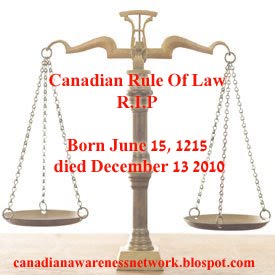
CANADIAN RULE OF LAW - Born June 15, 1215, died December 13 2010
There is no question in the fact that we live in a tyrannical dictatorship anymore.


